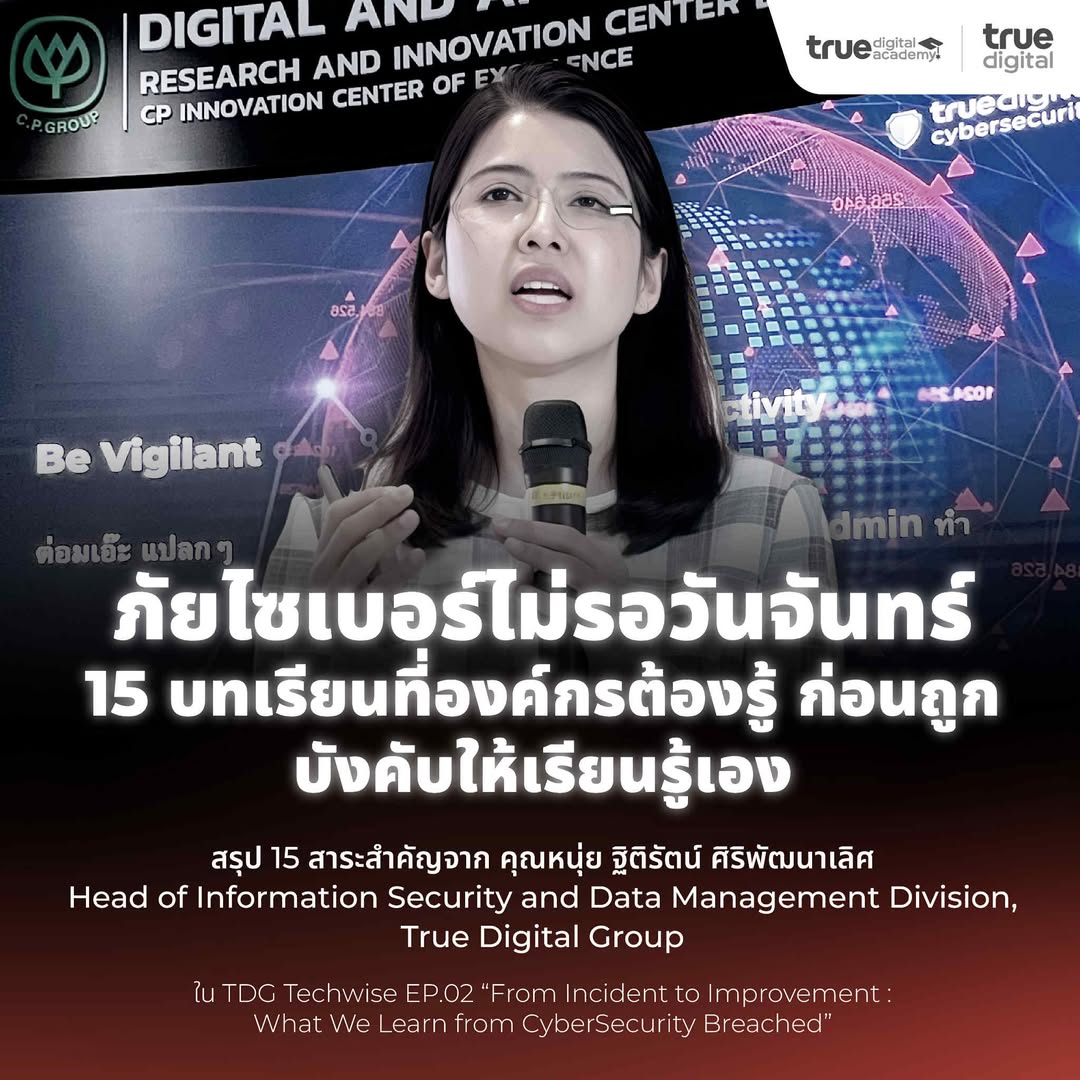
📌 Summary of 15 key insights from TDG Techwise EP.02 “From Incident to Improvement: What We Learn from Cybersecurity Breached” by Nui Thitirut Siripattanalert, Head of Information Security and Data Management Division, True Digital Group. This session helps organizations understand and learn lessons from cyber incidents, and outlines approaches to strengthening “cyber resilience” that organizations should adopt to cope with today’s cyber threats.
-
Cyber threats occur frequently and rapidly
Globally, cyberattacks happen every 39 seconds, and it takes an average of only 62 minutes from initial access to a successful breach. Organizations must have real time detection and response systems, not wait until incidents occur before reacting. -
Detect and stop threats within 1 hour
The goal of effective response is “detect within 1 minute, analyze within 10 minutes, and stop the threat within 60 minutes” to prevent damage from spreading, supported by an incident response team operating 24/7. -
Attack methods are increasingly complex and constantly evolving
Previously, attacks relied mainly on malware or phishing emails. Today, attackers exploit common system vulnerabilities such as Windows or applications, along with social engineering, deepfake techniques, and supply chain attacks. This makes detection more difficult and requires continuous system updates and patching. -
Data theft and the dark web market have grown by more than 112 percent
Attackers are increasingly financially motivated. Data protection and encryption of sensitive data are essential, along with multilayered security defenses rather than relying solely on firewalls or antivirus software. -
Ransomware remains a severe threat
Attackers continuously adapt. Some organizations respond too slowly, resulting in massive losses of data, systems, and money from ransom payments. -
Organizations must have 24 hour monitoring
Attacks often occur at night or during holidays. Having a security operations center or real time alerting systems helps reduce damage and control incidents more quickly. -
A clear incident response plan helps contain incidents faster
Organizations must have well defined plans and procedures outlining who is responsible, how investigations are conducted, and when connections should be cut to prevent attacks from spreading. -
Fully understand organizational digital assets
By creating an asset inventory and network diagram, organizations know which systems are connected, who is responsible for each, and can quickly identify owners and limit the scope of attacks within minutes. -
The biggest weakness is human negligence
Carelessness such as using weak passwords, connecting personal devices to corporate systems, or exposing remote desktop services publicly increases risk. Organizations should implement password policies, MFA, and continuous training. -
Risks from partners and third parties must not be overlooked
Even if an organization is secure, breaches at partners can expose connected systems. Vendor risk assessments and shared security standards are therefore essential. -
Organizations that ignore alerts often become victims
When alerts are triggered but ignored, not investigated further, or poorly communicated between IT and system administrators, organizations may fall victim to attacks, leading to service disruptions, massive revenue losses, or losses exceeding billions from ransomware or software ransom payments. -
Cybersecurity must integrate people, process, and technology
Technology alone is insufficient. Skilled people and practical processes are required to achieve effective prevention and response. This includes properly deploying and configuring EDR on all endpoints, defining policies to alert only on critical events, and using whitelists and configurations to reduce false alerts and improve detection accuracy. -
Cybersecurity is no longer just an IT issue
It is a strategic organizational risk that affects reputation, trust, and business value. Without preparedness, organizations may lose data and business opportunities in a very short time. -
A culture of “questioning” is the strongest defense
Organizations that survive often cultivate a vigilant mindset where everyone knows their role and does not ignore anomalies, especially when alerts are raised. -
Collaboration and continuous learning are the core of cyber resilience
Cybersecurity is not a one time effort, but a continuous learning cycle based on real incidents through post incident reviews. This strengthens systems and builds awareness across all levels of the organization, not only within IT teams.
Key takeaway summary
Cyberattacks may be unavoidable, but damage can be prevented if organizations are willing to learn from every incident and do not let mistakes pass without improvement. Ultimately, cybersecurity is not only about technology, but about collaboration across the entire organization to maintain trust every day.
Interested in digital upskilling courses from True Digital Academy? Visit: https://www.truedigitalacademy.com/enterprise
#TrueDigitalGroup #EmpoweringDigitalEquity #TrueDigitalAcademy #technology #innovations