Bangkok, 1 December 2025. True Corporation continues to support people affected by the southern floods. The company leverages its strength as a leader in telecommunications and technology, combining the power of the True 5G network after the completion of the nationwide One Network integration, supported by strong cybersecurity. Beyond maintaining the best possible continuity of communication services, True enhances its relief efforts through the Mobility Data Platform from True Digital Group. This platform supports government agencies in monitoring and managing the flood situation in real time by using massive datasets that can identify high-risk areas much faster than before. It helps improve the speed and efficiency of assistance for affected communities and strengthens planning for recovery so that people and businesses in the south can return to normal life as quickly as possible.
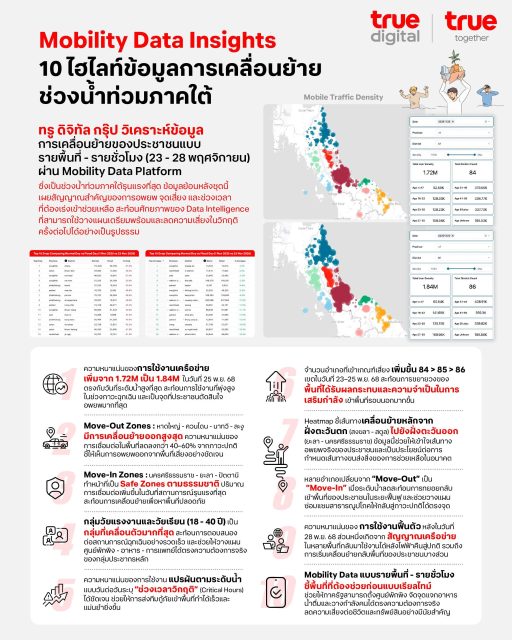
True Digital Group analyzed population movement across the True 5G network using the Mobility Data Platform starting from 20 November 2025 and detected unusual evacuation patterns in several areas, indicating that water levels were rising to dangerous levels. For example, the population in Chana District of Songkhla Province decreased by up to 68 percent, followed by Khuan Don District in Satun and Na Thawi District in Songkhla. Hat Yai District recorded the highest outbound movement. These signals highlight the wide-scale impact and the urgent need to deploy additional support teams.
During the period from 23 to 28 November 2025, which marked the peak of the crisis, the insights revealed several important patterns. Network usage density reached its highest point on 25 November 2025. Outbound movement from high risk areas in Hat Yai, Khuan Don, and Na Thawi dropped by more than 40 to 60 percent compared with normal conditions. At the same time, Nakhon Si Thammarat, Yala, and Pattani emerged as natural safe zones that absorbed large numbers of people. The data also highlighted the main evacuation routes from the western side to the eastern side, along with the shift in many districts from outbound zones to areas where people returned once water levels started to recede. These insights allowed agencies to identify critical moments and plan targeted support more effectively.
Mr. Ekaraj Panjavinin, Chief Digital Officer of True Corporation, stated that “Data from the Mobility Data Platform allows us to see what the human eye cannot immediately detect, including population density, unusual movement patterns, and evacuation routes. These real time insights can be used to support the work of government agencies and relief teams by enabling faster and more precise decisions when helping people in urgent need, which reduces the risk of loss of life and property.
Using the power of the True 5G network together with network usage data under legal and transparent frameworks, combined with the intelligence of digital technology, represents an example of Data Intelligence for Public Good that True is committed to applying for the benefit of society. True is ready to collaborate with government agencies that need aggregated statistical data from the Mobility Data Platform, which contains no personally identifiable information, and to jointly analyze deeper insights that fit the unique context of each area so that recovery can proceed as quickly and effectively as possible.”
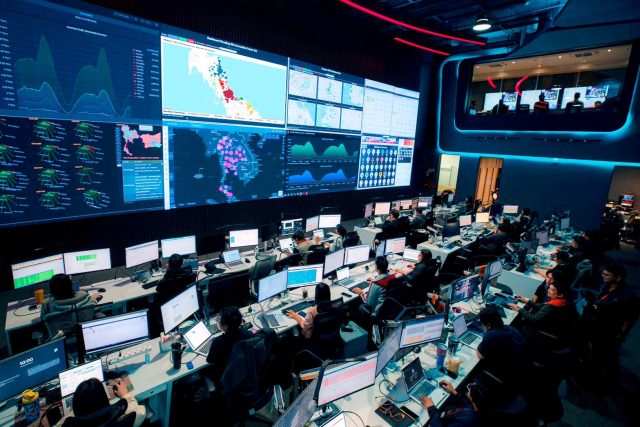
The Mobility Data Platform serves as a central hub for multi-dimensional insights, ranging from hourly and daily population data (Population Density Real Time) to demographic insights such as the presence of children, the elderly, and vulnerable groups in high-risk areas. It also provides instant alerts when unusual population changes occur (Abnormal Movement Alert) and offers a Before–During–After comparison system that clearly shows how conditions in each area change over time. This helps agencies manage crises and plan post-flood recovery more effectively.
These insights can be applied in two key phases:
- Rescue Phase: Identify areas requiring urgent assistance, determine supply routes, and prioritize support for high-risk groups.
- Recovery Phase: Assess the return of residents, evaluate the readiness of utilities, schools, hospitals, and workplaces, and support rapid and efficient restoration of normal conditions.
“The combination of intelligent networks, high-quality real-time data, and digital technology creates multi-dimensional insights that can be used both in normal situations and during crises. This is a vital role of technology in the digital era that helps drive the country forward and strengthen long-term recovery capacity,” Mr. Ekaraj concluded.